The Ten Commandments & the New Testament
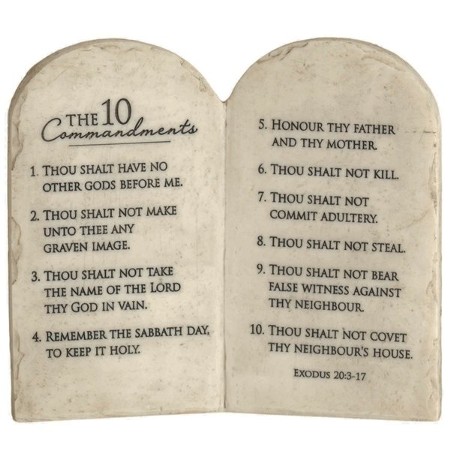
When the Son of God came down on Mt. Sinai, He thundered out the Ten Commandments in His own voice (Exod. 20). The people were so terrified, they told Moses to go and hear the voice and then come back and tell them what the Lord said. Afterwards, Moses ascended Mt. Sinai to receive the Ten Commandments written on two tablets of stone by the finger of God (Exod. 31:18). These two stone tablets contained two categories of commands. The first category described man’s direct obligation to God, commandments 1-4. The second category dealt with man’s obligation to his fellow man, commandments 5-10.
JESUS & the TEN COMMANDMENTS
Jesus summarized the two categories of commandments using quotes from Deuteronomy.
Mark 12:28-31 (NKJV) 28 Then one of the scribes came, and having heard them reasoning together, perceiving that He had answered them well, asked Him, “Which is the first commandment of all?” 29 Jesus answered him, “The first of all the commandments is: ‘Hear, O Israel, the LORD our God, the LORD is one. 30 And you shall love the LORD your God with all your heart, with all your soul, with all your mind, and with all your strength.’ This is the first commandment. 31 And the second, like it, is this: ‘You shall love your neighbor as yourself.’ There is no other commandment greater than these.”
In referring to the greatest of all commandments, Jesus quoted Deuteronomy 6:4-5 which was Moses’ commentary on the first stone tablet which outlined man’s obligation towards God. The “second” greatest commandment referred to the second stone tablet, which was summarized by Moses in Leviticus 19. Jesus quoted from verse 18 which was a summary of commandments 5-10.
When Jesus was questioned regarding which commandments were essential if one is to inherit immortality, Jesus quoted several of the Ten Commandments, all from the second stone Tablet.
Matt. 19:16-21 (ESV) 16 And behold, a man came up to him, saying, “Teacher, what good deed must I do to have eternal life?” 17 And he said to him, “Why do you ask me about what is good? There is only one who is good. If you would enter life, keep the commandments.” 18 He said to him, “Which ones?” And Jesus said, “You shall not murder, You shall not commit adultery, You shall not steal, You shall not bear false witness, 19 Honor your father and mother, and, You shall love your neighbor as yourself.” 20 The young man said to him, “All these I have kept. What do I still lack?” 21 Jesus said to him, “If you would be perfect, go, sell what you possess and give to the poor, and you will have treasure in heaven; and come, follow me.”
This dialogue is fascinating in that Jesus limited the necessary commandments to those written in stone with the finger of God. Jesus did not say anything about animal sacrifices or any of the other 600+ commands that were binding on Israel under the Law of Moses. He then concluded with the summary statement concerning one’s obligation in society, “You shall love your neighbor as yourself.”
In the Sermon on the Mount, Jesus referenced certain of the Ten Commandments while instructing His disciples. His instructions did not negate any of them. Rather, He expanded upon them. Jesus strengthened the 6th commandment: “You shall not murder…” (Matt. 5:21); and He strengthened the 7th commandment: “You shall not commit adultery…” (Matt. 5:27). Regarding ordinances of the Mosaic Law, Jesus certainly reversed certain ones such as “eye for eye, and tooth for tooth” (Matt. 5:38) or swearing oaths (Matt. 5:33-34).
PAUL & the TEN COMMANDMENTS
In Romans 1, Paul proved that the pagans were reprobate and rejected by God. In chapter 2 he showed that the Jews were hypocrites, no better than the pagans by using the Ten Commandments as the standard.
Rom. 2:22-23 (ESV) 22 You who say that one must not commit adultery (7th comm.), do you commit adultery? You who abhor idols (1st comm.), do you rob temples? 23 You who boast in the Law dishonor God by breaking the Law.
Notice that Paul’s use of “Law” referred specifically to the Ten Commandments not to any of the other 600+ Mosaic ordinances. He then referred to Gentile Christians who did not receive the Ten Commandments at Mt. Sinai, yet who have this same Law “written in their hearts.”
Rom. 2:14,26-26 (ESV) For when Gentiles, who do not have the Law, by nature do what the Law requires, they are a Law to themselves, even though they do not have the Law. 15 They show that the work of the Law is written on their hearts, … 26 So, if a man who is uncircumcised keeps the precepts of the Law, will not his uncircumcision be regarded as circumcision?
In the next chapter, Paul shows that no one has been able to keep the Ten Commandments perfectly and that the design of these commandments was to establish the knowledge of sin. Paul then claimed that the Law, the Ten Commandments, makes the whole world accountable to God. This is only possible if the whole world, not only Israel, is responsible before God to keep the Ten Commandments.
Rom. 3:9-10,19 (ESV) 9 What then? Are we Jews any better off? 2 No, not at all. For we have already charged that all, both Jews and Greeks, are under sin, 10 as it is written: “None is righteous, no, not one; … 19 Now we know that whatever the Law says it speaks to those who are under the Law, so that every mouth may be stopped, and the whole world may be held accountable to God. 20 For by works of the Law no human being will be justified in his sight, since through the Law comes knowledge of sin.
The word “Law” cannot possibly include the 600+ commandments of the Mosaic ordinances intended to govern the nation of Israel. The context of chapters 1-3 shows that Paul used the term “Law” for the Ten Commandments. The Mosaic ordinances required a priesthood and sacrifices, which none of the Gentile nations could possibly keep as these were very specific to the nation of Israel and the tribe of Levi as priests.
Paul then summarized the second Tablet, instructing Christians in how all of those commands are the practical working out of the foundational principle, “You shall love your neighbor as yourself.”
Rom. 13:8-9 (ESV) 8 Owe no one anything, except to love each other, for the one who loves another has fulfilled the Law. 9 For the commandments, “You shall not commit adultery, You shall not murder, You shall not steal, You shall not covet,” and any other commandment, are summed up in this word: “You shall love your neighbor as yourself.”
The two great commands, love God and love your neighbor, were never meant to replace the Ten Commandments, but to summarize them. That is precisely how the Old Testament treats these summary statements. Why then would they mean something entirely different when repeated in the New Testament?
Paul quoted the 5th commandment as binding on Christian children and included the promise attached to it as applicable. This could not be said if the Ten Commandments had been abolished.
Eph. 6:1-2 (ESV) 1 Children, obey your parents in the Lord, for this is right. 2 “Honor your father and mother” (this is the first commandment with a promise), 3 “that it may go well with you and that you may live long in the land.”
In 1 Timothy, Paul declared that the Ten Commandments are good and valid and in accord with his Gospel message.
1 Tim. 1:8-11 (ESV) 8 Now we know that the Law is good, if one uses it lawfully, 9 understanding this, that the Law is not laid down for the just but for the lawless and disobedient, for the ungodly and sinners, for the unholy and profane, for those who strike their fathers and mothers (5th comm.), for murderers (6thcomm.), 10 the sexually immoral, men who practice homosexuality (7thcomm.), enslavers, liars, perjurers (9thcomm.), and whatever else is contrary to sound doctrine, 11 in accordance with the gospel of the glory of the blessed God with which I have been entrusted.
Notice that Paul used the present tense. He did not say that the Law was good, and that the Law was not laid down for the just. Paul considered its jurisdiction as current and binding on all humanity and “in accordance with the Gospel.”
In Hebrews 4:1-11 Paul referenced the original Sabbath Rest, the 4th commandment, applying it to Christians.
Heb. 4:9-11 So then, there remains a Sabbath rest for the people of God, 10 for whoever has entered God’s rest has also rested from his works as God did from his. 11 Let us therefore strive to enter that rest, so that no one may fall by the same sort of disobedience.
While it is clear from the context that Paul was referring to the Millennial Kingdom as the future “Sabbath rest” which we must strive to enter, his entire argument would be rendered moot if the 4th commandment was not binding on Christians. His whole argument makes the original and subsequent weekly observance of the Sabbath day a symbol of the 7th Millennium, the Millennial Sabbath. Thus, by necessary inference, the 4th commandment is assumed for Christians as both a memorial of God’s resting at creation (Exod. 20:11) and a prophecy of the Kingdom.
JAMES & the TEN COMMANDMENTS
James quoted the 6th and 7th commandments to show that those who break these are now guilty of breaking all. The use of the present tense verbs shows that James considered Christians to be obligated to the Ten Commandments in these verses.
James 2:8-12 (ESV) 8 If you really fulfill the royal Law according to the Scripture, “You shall love your neighbor as yourself,” you are doing well. 9 But if you show partiality, you ARE committing sin and ARE convicted by the Law as transgressors. 10 For whoever keeps the whole Law but fails in one point has become accountable for all of it. 11 For he who said, “Do not commit adultery,” also said, “Do not murder.” If you do not commit adultery but do murder, you have become a transgressor of the Law. 12 So speak and so act as those who are to be judged under the Law of liberty.
James called the Ten Commandments “the Law of Liberty,” not because it was abolished, but because we have access to continual cleansing from sin which frees us from the curse of the Law (Gal. 3:13), since “the wages of sin is death, but the gift of God is eternal life in Jesus Christ our Lord” (Rom. 6:23). As both Paul and James stated, the Ten Commandments still provide the knowledge of sin, and those who break the Ten Commandments “are committing sin.”
Finally, Revelation refers to the conquerors during the tribulation as “those who keep the commandments of God and hold to the testimony of Jesus” (Rev. 12:17; Rev. 14:12). Notice how this perfectly parallels Jesus’ statement to the Rich Young Ruler in Matt. 19:16-21. These are the ones of which John says, “His bride has made herself ready” (Rev. 19:7). As we approach the end of the age, we should be judging ourselves by both the Ten Commandments and the Law of Christ so that we are not judged (1 Cor. 11:31).
My comments should not be understood as claiming that salvation comes by keeping the Ten Commandments in addition to faith in Christ. Rather, my comments should be understood as demonstrating that the “Law of Christ” does not abolish the Ten Commandments, but rather “the Law of Christ” is a supplement to the Ten Commandments.